Sunday, October 27, 2019

Curo Makes Multiples for CEO


Strange Tony,

Think back to your hospice days.  Would you or any of your co-workers have found these words inspiring?

“You have very high multiples right now with the demographics that are trending; those multiples have to come down over time if you look at historical averages,” Larry Graham, founder and CEO of hospice and home health provider Curo Health Services said at Summit. “Private equity is very interested in the home care and hospice space which is driving up multiples at this point in time. I think the future changes to reimbursement, such as the [Medicare Advantage carve-in] will have an impact on multiples coming down.”  

Private equity are the financial rapscallions that partnered with Humana to buy Kindred at Home and Curo Health Services.  They crammed our hospice into Curo, and together they destroyed our level of service.

What Graham didn't say is he made big money under various financial rapscallions.  


Larry Graham co-founded Curo in April 2010 with GTCR, a Chicago based private equity firm.  He made huge profits from the next two sales of Curo Health Services to private equity owners.    Graham got a chunk of the $730 million Thomas H. Lee paid GTCR for Curo in 2015.  Three years later Curo's speculative debt rating went negative.  In July 2018 Graham got a portion of the $1.4 billion Humana, TPG Capital and WCAS paid Thomas H. Lee for Curo.

Graham partnered with financial rapscallions from day one with Curo.  His wealth is beyond what a normal person could spend in several lifetimes.  The rabid pursuit of more money does not make hospice better.  It makes it worse for employees, physicians, patients and families.

At the same conference Graham said "I am a firm believer in technology" and "the overall goal will be keeping patients out of the hospital."  Curo's technology cheats employees on paid time and mileage reimbursement.  The clinical portion of Homecare Homebase is garbage in-garbage out at our hospice as nurses don't have time to take the program's various rabbit trails. 

That's a nice stripped suit.  Over time Curo's technology may have CEO Graham switching suits to one with more white.

Anonymous

Wednesday, October 16, 2019

Humana CMO Shrank Our Hospice


Strange Tony,

Humana Chief Medical Officer William Shrank spoke with "Home Health Care News" about:

"Humana’s efforts surrounding social determinants of health, continuing health care trends and the ongoing alignment of the company’s in-home care operations."
Shrank failed to mention how Humana/Curo Health Services decimated our hospice by dramatically reducing staff, driving turnover through the roof and implementing garbage in-garbage out Homecare Homebase. 

Humana/Curo depersonalized our services by jettisoning or running off caring, experienced staff.  

"The future of being able to really care for vulnerable patients — ideally, in the home — is to coordinate all those resources. Coordinate them in terms of making sure everyone’s operating at the top of their license and focusing on their area of expertise, but more importantly that everyone’s working on a longitudinal patient medical record that allows them to communicate with each other."
Longitudinal record?  I didn't realize ten months of information was considered longitudinal.  Also there is nothing longitudinal about information that does not carry forward when hospice certification period ends and a new one begins.

Humana/Curo have harmed our hospice's ability to care for vulnerable patients.   They also harmed employees by not paying them fairly for hours worked and miles driven.  Humana has done nothing but hurt our hospice's care delivery.  Curo is a curse.

Anonymous

Tuesday, October 8, 2019

Humana Imposed Waste at Kindred Hospice


Strange Tony,

Humana led a study on healthcare waste while imposing the same on our hospice.  News reports indicated:

Researchers from Humana Inc. (HUM) and the University of Pittsburgh School of Medicine estimated the cost of waste in the United States (U.S.) health system. The study found that approximately 25 percent of health care spending can be characterized as waste – between $760 billion and $935 billion annually.
I have directly experienced Humana's wasteful management at our hospice.  Our complex payroll function within Homecare Homebase wastes numerous hours for employees wishing to be paid accurately for their work.

Every pay period the system does what used to be called a time and motion study.  Each employee must account for their time down to the minute.  Because the system won't allow you to start the next segment with the previous segment's ending time, an employee loses that minute.  At the end of the day the system could've robbed an employee of ten to fifteen minutes of actual worked time.

The robbery gets worse when Homecare Homebase's mileage reimbursement system only automatically pays for the trip to see the patient.  For an employee to be paid for their return trip to the office they must manually enter that into the mileage system.

Management did not train staff on the time or mileage system under Homecare Homebase and many employees were shorted as a result.  Five months after going live management offered to bring someone in to train staff on both functions.  Staff agreed that would be helpful.  It hasn't happened to date and I doubt it will.

Humana believes Kindred at Home will help reduce waste in its Medicare Advantage population.  My experience is they imposed significant waste.  It used to take 10-15 minutes to input worked hours.  It now takes two hours per pay period.  That's just to roll the dice and see if management will approve the submissions for payment.  More time is needed to study the check and find discrepancies (if shorted).

Homecare Homebase is a nightmare in complexity for employees wanting to be paid fairly for hours worked and miles driven.  I do not understand how hours worked in a just closed pay period can not be paid and added to a month that has long gone by.  That happened frequently at our hospice.

Another bureaucratic time waster is scheduling every visit.  This works fine for Home Health but makes no sense for hospice.  On call and regular staff wasted hours waiting for management to add the visit and push an assignment.   This also happened with our nurse practitioners needing to do face-to-face visits.  We look bad when a nurse practitioner travels to do a face-to-face visit in a facility and there is no visit note for them to complete.  It becomes a paper visit or a redo.  

Humana's study on administrative waste applies to our hospice.  It's ironic that Humana imposed the wasteful system after buying our hospice in July 2018.   Forgive them Lord, they know not what they do.  Or do they?  Lord, forgive them anyway.

Anonymous

Friday, September 6, 2019

Kindred at Home/Curo's Hospice Staffing Model


Strange Tony,

Last August I gathered comments on Curo Health's hospice staffing model.  Their words ended up as accurate predictions for changes at our hospice over the last year.   Over 50% of staff left, voluntarily or involuntarily.

A former executive shared Curo's staffing model.  It is sparse and not capable of delivering good customer service, at least that has been my experience.


Kindred at Home home health locations are undergoing the same decimation process as our hospice.  They are converting to Homecare Homebase which was supposed to save our hospice lots of work.  It did not.  Homecare Homebase added significant busy work and it underpaid my co-workers for time worked and miles driven.

My vision was to work for a company that could accurately pay employees and staffed for outstanding customer service.  That is not Kindred at Home/Curo Health Services under the ownership of Humana and two financial rapscallions.  That is a tragic development.

Anonymous

Wednesday, August 21, 2019

Curo's Sick Model and Bad Technology


Strange Tony,

I'm afraid our hospice is terminal from severe management disease.  It began a year ago when Humana purchased our hospice and placed us under Curo Health Service CEO Larry Graham. What they've done together to our site is a crying shame.

Executives knew the plan and the corresponding carnage it would cause.  Step One:  They handcuffed a few people they thought critical to the company's success with retention bonuses.  Step Two:  Once these people were strapped down the firings began.  The terminations haven't stopped.  In an employee update call executives referred to their mendacious plans as a "bumpy year for employees."

Nothing about their plan respected teamwork, once a hallmark of our hospice.  In our heyday everyone mattered.  There were experienced people with time and patience to shepherd new employees.  People were trained to do the job.  No more.

Step Three:  Leave few to no standard bearers.  The few that remain hate what Humana/Curo has done to our hospice.  Curo management has a unique inability to listen.  Step Four:  Label those speaking out as "negative" and deride them for sharing their employee experience.   Ignore that these people were recently the "go to" people for their discipline.

Secure leaders would view what was shared as feedback.  Staff know and have experienced consequences of ongoing management greed and callousness. We just can't honestly share our experiences with anyone up the chain without retaliation.

Executive greed cut nearly everything in the last year, health insurance benefits, holiday pay, staffing, space, color printer, employee appreciation day, floating holiday, post it notes, cellphones, IPADS, computers, employee going away parties and parking spaces.  We just learned some pinhead in Mooresville wants us to pay for parking.  Shaming the Future Together - Curo and Kindred at Home.

They use spreadsheets to underpay staff for miles driven and hours worked.  Loss of pay is compounded by mean girl management, which can viciously cut a hospice heart.  I pray God return to them tenfold what they have foisted on others.

Anonymous

Wednesday, August 7, 2019

Kindred at Home/Curo Health Employees Tell Friends to Stay Away


Strange Tony,

Management's obsession with measures, big data and artificial intelligence only apply to their greedy priorities.  One year ago Humana bought Curo Health Services, a collection of regional hospices established by financial rapscallions in 2010.   Humana placed Kindred at Home's hospice division under Curo's "innovative" management.  In the last year Curo decimated our once great hospice.

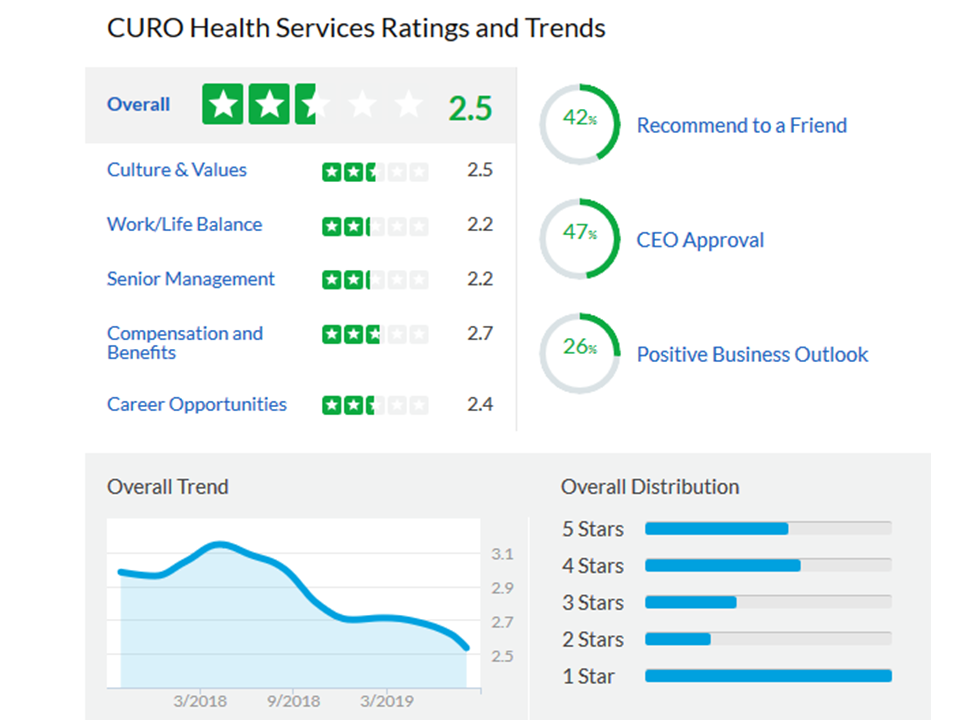
Glassdoor collects data from employees about their experience.  One can look at three companies on Glassdoor to get a feel for Humana's Home portfolio, Kindred at Home, Kindred Hospice and Curo Health Services.  As Curo management has been innovative in the ways they've tortured our hospice let's start there.

Less than half of Curo's employees support its leadership, believe in its future and would recommend a friend work alongside them:


Roughly a third of Kindred at Home employees would recommend the company to a friend (35%) and have a positive business outlook (36%).

Leadership leaves Kindred at Home and Curo employees uninspired, which can be seen in Curo's overall rating trend from employees:


I did not see one regional executive visit our office from July 2018 to July 2019.  Feedback, like excrement, only goes one way, downhill.

Homecare Homebase's garbage in-garbage out hospice system has been a time killer for staff, both clinical and office.   


The company's answer to overworked nurses was to make them salaried.  Humana/Curo Executives get an A in Abusive Management 600, a course required by our 60% financial rapscallion owners.  Abuse leads to no hope.


Yet employees know who is responsible.


Each graph peaked as Humana bought Kindred at Home and Curo Health Services.  Employees experienced harm after these deals and the ratings slide began.

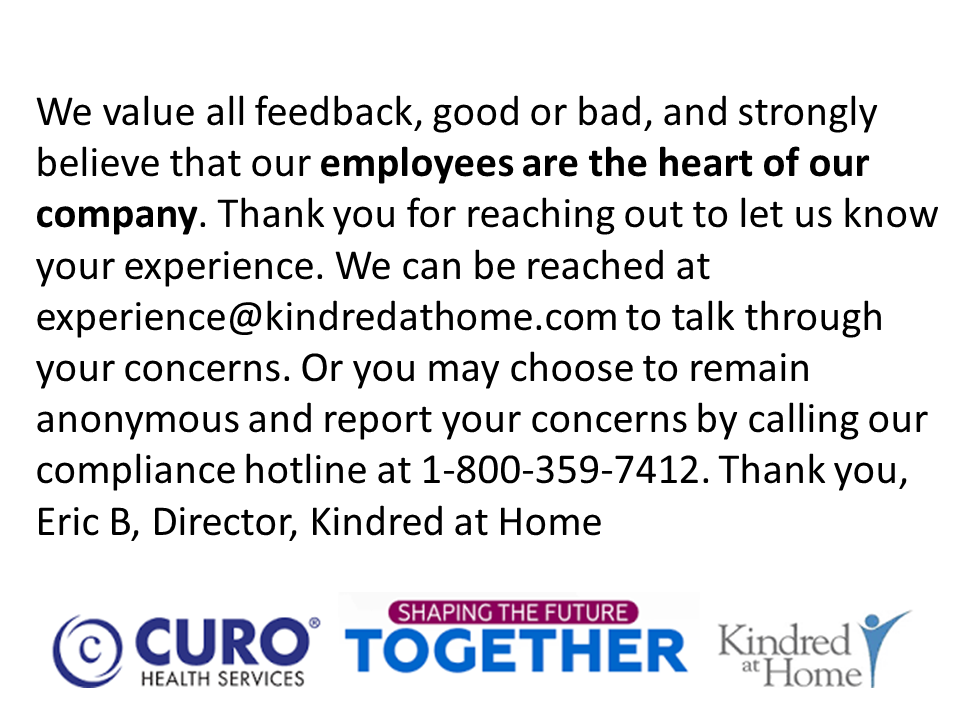
The company has a consistent artificial response to those raising issues of no raises, horrible management and declining quality care. 

Employees may be the heart in that we keep pumping but the company has shown us no love.   How long will workers stay under executive disdain, hollow phrases and false embraces?

Anonymous

Thursday, August 1, 2019

Kindred Barely Mentioned in Earnings Call


Strange Tony,

Humana held its Q2 earnings call and Kindred got but a few mentions.  Most of those are below:

In the home through our minority investment in Kindred at Home, we are piloting value-based care models in multiple markets and continue to see encouraging results from a standalone financial perspective for Kindred at Home, and from the standpoint of delivering improved clinical outcomes for our members. To usher in the next wave of integration, Humana and Kindred at Home have invested in an interdisciplinary team of clinicians responsible for taking the best practices gleaned from pilot markets and applying those learnings across Kindred’s broad geographic footprint.

... healthcare services is performing above expectations and we increased our adjusted EBITDA guidance for the full year by approximately $40 million ...  Our home business, including Kindred at Home, is performing well.  

....having new distribution channels that we’ve created, whether it’s Kindred or a PIPC or other areas where we can engage our members in different ways, that’s why we continue to invest those channels and in the technology that supports it so we can continue to manage our medical costs.   

All of our costs are estimated, and so it’s important to identify these early warning systems that can allow us to identify the issues and then create the clinical programs and the customer engagement platform, and frankly the analytics to be able to identify who needs the intervention. We continue to invest in that. We’re nowhere near where we need to be.  

I would say that the outperformance is pretty balanced across the board...  Where we’re seeing, I’d say, greater percentage outperformance is on the Kindred side.   ... the Kindred team is really executing on the business plan.

Humana's 40% interest in Kindred's earnings grew 300% from Q1.  Historically the first six months delivered stronger hospice volumes and revenues than the latter half of the year.  

Humana/Curo operated our Kindred Hospice as a cost center that needs massive ongoing cuts.  So far dramatic reductions in service levels have not translated to reduced patient census.  They have hurt billing.  At one point our hospice had $750,000 in unbilled care.  That's been cut in half.   

Before Humana/Curo foisted cumbersome Homecare Homebase on our hospice our unbilled revenue rarely reached $75,000.  That was under higher volumes.  

Humana and partner financial rapscallions milk our hospice at the expense of quality clinical care.  We're nowhere where we used to be. 

Anonymous