When hospice reverts to the lowest common denominator and leaders obsess about metrics, it's time to speak. Self-inflated leaders assume clinicians give until their backs break, given no raises for years. A clinical ladder is a rainbow’s pot of gold. Others have a sorrier job and must be motivated by money. Abysmal leaders dangle extrinsic rewards for admission, hiring and EDBITA targets. “Sign on” bonuses entice people into a poor work environment. Employees’ voice equals their raise, zero.
Thursday, December 19, 2019
Humana Enriches More Executives
Strange Tony,
Humana CEO Bruce Broussard sold company stock before Christmas as did thirteen other executives. Broussard received $21.7 million for his shares. Broussard's stock sale is 4.6 times more than the $4.7 million Kindred contributed to employee 401(k) retirement accounts in 2018.
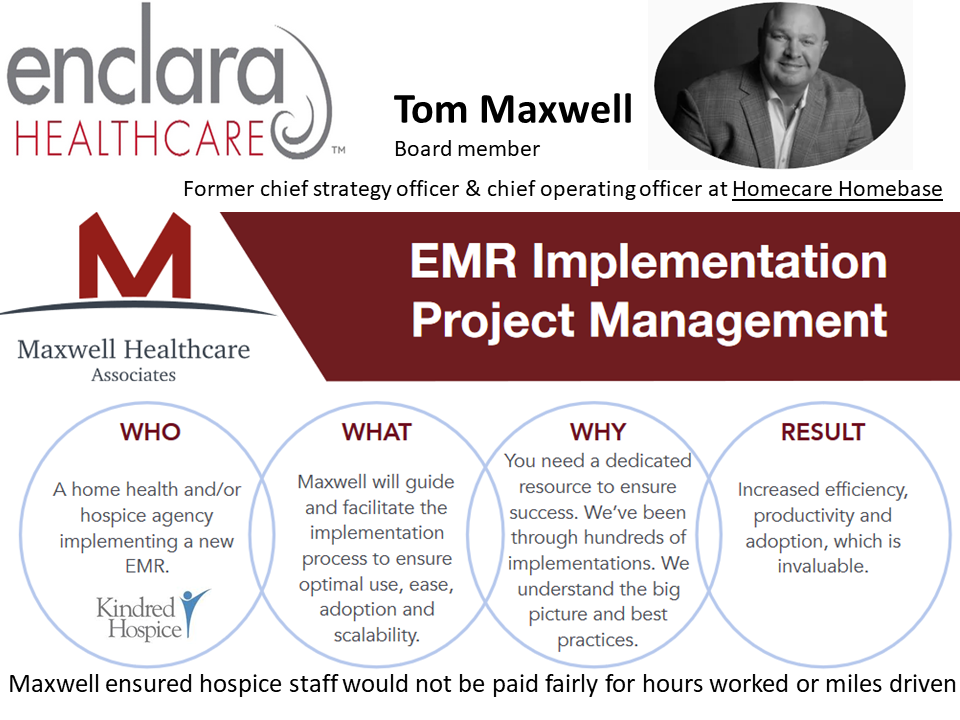
Humana enriched former Homecare Homebase Chief Operating Officer Tom Maxwell when it announced it would buy specialty hospice pharmacy provider Enclara Healthcare. Maxwell is an Enclara board member and owns healthcare consulting firm Maxwell Healthcare Associates.
Over a year ago Humana influenced the Kindred at Home board to go with Homecare Homebase. Maxwell Health Associates assisted our hospice with its Homecare Homebase go live. Maxwell consultants ensured staff was not be paid fairly for hours worked or miles driven.
While valuable staff members were laid off Tom Maxwell made big money from Kindred at Home's conversion to Homecare Homebase. He will make big money again when Humana closes the Enclara deal.
Two former Medicare Chiefs are directly involved with Humana/Kindred at Home or Enclara. Obama Health Reformer Nancy Ann Deparle will profit handsomely in her role as founder of financial rapscallion Consonance Capital. Bush II Medicare Chief Tom Scully owns a chunk of Kindred at Home via financial rapscallion Welsh, Carson, Anderson and Stowe. He will make massive profits when Humana buys the rest of Kindred at Home from Humana at grossly inflated prices. Broussard once worked for another Welsh Carson affiliate, U.S. Oncology and traded Concentra with WCAS as Humana's CEO.
Kindred Hospice workers toil under bad management and ineffective computer systems. The spoils do not trickle down to the people doing the billable work. Workers vote with their feet daily by leaving. Executives have neither eyes to see or ears to hear. They do have fingers to count their earthly gains which remain on this planet when they receive God's final judgement.
Anonymous
Sunday, December 1, 2019
Toad Kicks Off "Gather Your Own Straw" Program
Strange Tony,
The day after Thanksgiving First Senior Regional Executive Vice President Toad introduced Kindred at Home's latest executive initiative to our hospice. The mandatory meeting occurred on Black Friday.
FSREVP Toad: "Our new program is based on a story from the Bible, one Kindred at Home executives and our investor dominated board discussed in a retreat. As a group they asked 'How can we be more like that guy?'"
Employee #1: "Jesus?"
Toad: "Nope. Think Old Testament. Any guesses?
Employee #2: "Moses?"
Toad: "No."
Employee #2: "David?"
Toad: "Guys, it's the Pharaoh! I'll read the verses that moved senior executives and our board of directors:"
Pharaoh gave this order to the slave drivers and overseers in charge of the people: 7 “You are no longer to supply the people with straw for making bricks; let them go and gather their own straw. 8 But require them to make the same number of bricks as before; don’t reduce the quota. They are lazy; that is why they are crying out, ‘Let us go and sacrifice to our God.’ 9 Make the work harder for the people so that they keep working and pay no attention to lies.”10 Then the slave drivers and the overseers went out and said to the people, “This is what Pharaoh says: ‘I will not give you any more straw. 11 Go and get your own straw wherever you can find it, but your work will not be reduced at all.’” 12 So the people scattered all over Egypt to gather stubble to use for straw. 13 The slave drivers kept pressing them, saying, “Complete the work required of you for each day, just as when you had straw.” 14 And Pharaoh’s slave drivers beat the Israelite overseers they had appointed, demanding, “Why haven’t you met your quota of bricks yesterday or today, as before?”
Employee #1: "Since we don't use straw in caring for hospice patients what is it executives want from us?"
Toad: "We want you to complete the work required of you each day. We demand you meet productivity quotas established by top leadership. Straw is symbolic of whatever barrier you face in getting your daily work completed."
Employee #2: "How can you hold us to higher productivity standards after management eliminated key positions and gave us systems that hurt productivity?"
Toad: "Straw! You have to find your own. It's your responsibility to figure it out. The plan is to build institutional resilience from the ground up. Employees are the bricks."
Employee #2: "That makes no sense given the extra work management added. We spend more time scheduling. I have to wait for my work to be scheduled so I can actually do it. I spend hours now entering my time and mileage in order to be paid correctly. That usually doesn't happen so I spend hours figuring out how the company shorted me and how to resubmit time and mileage."
Toad: "What you described is the work required of you every day. Get 'er done."
Employee #3: "There aren't enough hours in a day to do what the company expects."
Toad: "Time is straw. Straw is time. Make your own."
Employee #4: "Under Kindredlink it took me two hours to prepare for IDG. Homecare Homebase increased that to a full eight hour day. That's time eating, not time saving."
Toad: "Homecare Homebase was a strategic decision made by our board of directors, the same people who admire and emulate Pharaoh. Your personal inefficiency is very concerning. I will make a note of it and ask your direct overseer (DO) to beat, (clears throat) verbally berate you."
Employee #4: "Why did I open my mouth?"
Toad: "Any more questions on this new exciting executive initiative? Seeing none, I'd like to turn it over to the people in charge of ensuring this program is a success. The Bible calls them slave drivers but executives call them Area VP's and DCO's."
Employee #1 (under their breath): "We call them Mean Girls."
Mean Girl #1 (looking at Employee #1): "Speak up if you have something to say..."
Employee #1 slinks down in their chair.
Mean Girl #1 (pause): "Nothing? Didn't think so. (shifts gaze to whole group) You guys must be so proud. Your hospice is the first to pilot the "Gather Your Straw" program. I am so honored FSREVP Toad selected one of my hospices to start this exciting effort. Our fantastic Director of Clinical Operations is here to help you, so I will turn it over to her."
Mean Girl #2 DCO: "It's all about the employee experience which you now get to live 24 hours a day, seven days a week, although we only pay you for 40. As of today all nurses are salaried and hourly employees are prohibited from submitting overtime. If a employee submits overtime they will be disciplined for not using your time, straw, effectively. That discipline could result in termination. (Staff groan)
Toad:: "Gather Your Straw" puts you in charge of solving your own problems, so solve away."
Employee #3: "Can we have our time here not count against our productivity measures?"
Toad: "I'm afraid that's not possible. Any meeting with an executive like myself is considered optimal use of your time by the company. Remember the whole company is looking at this hospice. You'd better perform. Executives are counting on you."
Employee # 2 (spoken under their breath): "for their giant paydays while we break our backs."
Toad: "I would like to close with a prayer asking God's blessings for abundant admissions, census and margin. Is a chaplain willing to do that?"
None volunteered so we exited the meeting room deflated and diminished. It was the Blackest of Fridays. We'll see how many more leave the toxic wasteland fouled by Humana/Curo. The Bible says they will reap what they've sown Lord, deliver us from evil.
Anonymous
Friday, November 22, 2019
Toad Returns to Head Up New Executive Initiative
Strange Tony,
I learned that former Vice President Toad has rejoined Kindred at Home to head up a new program. He and the Mean Girls will be at our hospice site soon to kick it off. I understand we are the pilot for this new executive program.
Toad left shortly after the buyout by Humana and two financial rapscallions. At Mednax he helped trash a vibrant culture. That makes him a perfect fit as Humana/Curo decimated our hospice over the last year.
I am curious what mendacity Toad and his Mean Girls will foist on our already stressed to the max site. Lord, give us strength and peace in the coming maelstrom.
Anonymous
Saturday, November 16, 2019
Humana CEO on Kindred at Home Q3 Earnings Call
Strange Tony,
Do you have any insights for me on what this guy is saying? Humana CEO Bruce Broussard highlighted Kindred at Home in an Q3 earnings call on 11-17-19:
At the core of our strategy is interoperability, which facilitates our relationship with our provider partners, while simplifying the experience of our members. Recently Humana Pharmacy developed what we believe is the first clinical decision support fire integration in production between a payer and a provider via their clinical workflow. Our partner Signifyd Health is now using our OneMedList in connection with an in-home assessments, giving them the ability to confirm in real time member adherence to their medication and more proactively identify potential adverse drug interventions and drug disease conflicts.The Kindred Hospice nurse has to re-enter the complete med list with every re-certification in Homecare Homebase. As they are salaried and work 50-60 hour weeks the accuracy of the manually re-entered medlist may not be 100%. That will be uploaded to Humana, who will begin to see the garbage in-garbage out nature of HCHB. You can't have real time adherence to a medication the patient is no longer taking but remains in the system as a current medication.
During 2020 we will roll this same functionality to all Kindred at Home and other health care – health home health providers including integration with the new home care – home based system. The integration of technology like OneMedList with Kindred at Home is enabled by Humana's integration with the home care, home-based electronic medical record and practice management system. The integration allows the prescription drug information gathered by the Kindred at Home nurse to become part of the Humana record, ensuring a more comprehensive record and reducing the likelihood of medication errors.
This will accelerate our ability to proactively identify key clinical interventions while improving revenue capture and business and quality reporting.
...when we went into the Kindred investment, we went into it with the view that there would be reimbursement changes in there and those reimbursement changes would not only be rate impacted, but also just the way the business was going to the drivers of the business. And we are very excited about the changes of the reimbursement model, moving to a model that is going to reward more for nursing and reward more for chronic conditions as opposed to just therapy and be more oriented to less chronic conditions.
So first just the structural changes there we find are very helpful for our member base and then advancing the downstream costs, such as admissions and readmissions in addition complications of particular conditions in total. The second thing is when we constructed the deal and did our forecast, we constructed the deal with knowing that there would be a transition both – that would require operational transition, and in addition, require us from a financial point of view. And so, when we did the deal on it and based on our valuations, we also assumed this particular transition there.
That is one of the reasons why you saw the organization invest in technology in 2019 to be able to prepare for these changes. And I think, if you were sitting in the board room of Kindred, you would also see a number of other changes both from competencies, clinical programs and so on and preparing for it. So I think – the both Kindred and Humana are very active in that evolution.
Humana will enrich Kindred at Home executives and two financial rapscallions when it buys the 60% of the company it does not own for a 10.5 to 11.5 multiple of EBITDA. Kindred shareholders got a mere 8x multiple from Humana.The third thing is on the just the financial side and I would say that it is incorporated in our outlook for 2020 and the years beyond that. But I do also want to highlight that in, when we were to exercise the put or call it is on the operating performance post that reimbursement change. So it does reflect in the other 60% that we purchased on. So, in summary, we're very excited about the changes as it structurally changes the economics to take on the conditions that we feel are most important for our members.Secondarily, we have incorporated that in the transaction, both in the operating results that we see over the coming years. But then most importantly, as our – as we move to exercise in the put or call is, it will be reflected in the purchase price accordingly.
Broussard did not mention how Humana and the Kindred board keep ruining our once nationally recognized hospice. Curo technology is a Trojan Horse. Employees are under constant surveillance. That's devolving.
Anonymous
Sunday, November 10, 2019
Big Picture for Kindred at Home
Strange Tony,
Two web meetings addressed Kindred at Home's future under the ownership of Humana and two financial rapscallions, TPG and Welsh, Carson, Anderson and Stowe (WCAS). The first occurred on November 5th when KAH President David Causby and Hospice President/Curo Health Services founder Larry Graham held a fireside web meeting for employees.
Larry Graham offered information on benefit improvements, saying the company would increase PTO, holiday, disability and HSA funding benefits, while holding health insurance premium increases to a minimum for staff. Graham did not mention executives reduced most of those benefits for 2019, nor did he say how much of the prior cuts would be restored. He said the company intended to offer great care by great clinicians. I wondered when that would start.
David Causby encouraged employees to elect benefits for 2020, as they will not automatically carry forward. He then said all hospice and home health sites within the company, 787 locations, are live on Homecare Homebase. The conversion happened in nine waves with 40-50 sites per wave.
He used the words "difficult" and "time consuming" before shifting to the expectation of seeing improved outcomes. I expect those are financial because HCHB and all the Curo changes made our care much worse. He expressed appreciation for all the "great work you do, despite distractions." One regular distraction is the tremendous effort it takes in HCHB to be paid accurately for hours worked and miles driven. Neither executive mentioned that feature.
Causby talked about November and a number of major events, National Hospice and Home Care month, Home Health Aide week, Veteran's Day and the company's annual marketing blitz "Home for the Holidays." He spoke of key strategies and the need to grow the business beyond the 550,000 patients and families we serve per year.
David Causby talked about executives not living up to a communication plan and promised leadership communication on video in the future. He wants to create a family atmosphere, recognized it's been a very hectic year that stressed staff in many ways. He soft pedaled executives role in the carnage by saying we've "seen a lot of changes/challenges thrown at the organization." Translation: Aloof and absent executives have done a lot of tormenting of dedicated staff and destruction of quality hospice care. .
Larry Graham shared his vision of 2020 being the year the company returns to organic growth. Humana's 3rd quarter earnings reported referred to "slightly lower earnings from Kindred at Home operations." Our hospice's daily census for Q3 was below last year, I believe due to the chaos the company imposed on our site.
Causby said the journey is far from over, that continued heavy lifting will be needed for eventual Humana ownership. He reiterated the company is investing significantly in employee benefits. That's because Kindred/Curo benefits are far below Humana's and there's great catching up to be done. Humana knew this when they bought 40% of our company and then let Tweedledee Causby and Tweedledom Graham slash benefits for 2019.
Causby wants Kindred to be known for stellar clinical care and being innovative. Management's priorities are to provide enhanced benefits and show appreciation. The Curo way at our hospice has been the opposite of everything he stressed. Humana et al delivered poor clinical care, rigidity under bad systems, benefit cuts and zero acknowledgement of hard work and high performance by dedicated staff (most of whom are now gone).
The dastardly duo ended with a dark future under Humana with artificial intelligence determining the level of care and what day that should be delivered. The goal is to decrease hospitalizations for Humana's Medicare Advantage enrollees and decrease the live discharge rate for hospice. That might mean only admitting patients who actually qualify for hospice. The pressure to meet targets for admissions and average daily census had patients sneaking onto service that clearly did not qualify. That pressure grew after Humana, TPG and WCAS bought us in July 2018.
Humana plans to have a predictive clinical modeling platform and operate integrated markets across the various organizations Humana owns. The second web meeting occurred on November 7th. Humana CEO Bruce Broussard addressed Kindred at Home's future in Humana's Q3 earnings call with Wall Street analysts. I'll share those low-lights in another post.
Anonymous
Sunday, October 27, 2019
Curo Makes Multiples for CEO
Strange Tony,
Think back to your hospice days. Would you or any of your co-workers have found these words inspiring?
“You have very high multiples right now with the demographics that are trending; those multiples have to come down over time if you look at historical averages,” Larry Graham, founder and CEO of hospice and home health provider Curo Health Services said at Summit. “Private equity is very interested in the home care and hospice space which is driving up multiples at this point in time. I think the future changes to reimbursement, such as the [Medicare Advantage carve-in] will have an impact on multiples coming down.”
Private equity are the financial rapscallions that partnered with Humana to buy Kindred at Home and Curo Health Services. They crammed our hospice into Curo, and together they destroyed our level of service.
What Graham didn't say is he made big money under various financial rapscallions.
Larry Graham co-founded Curo in April 2010 with GTCR, a Chicago based private equity firm. He made huge profits from the next two sales of Curo Health Services to private equity owners. Graham got a chunk of the $730 million Thomas H. Lee paid GTCR for Curo in 2015. Three years later Curo's speculative debt rating went negative. In July 2018 Graham got a portion of the $1.4 billion Humana, TPG Capital and WCAS paid Thomas H. Lee for Curo.
Graham partnered with financial rapscallions from day one with Curo. His wealth is beyond what a normal person could spend in several lifetimes. The rabid pursuit of more money does not make hospice better. It makes it worse for employees, physicians, patients and families.
At the same conference Graham said "I am a firm believer in technology" and "the overall goal will be keeping patients out of the hospital." Curo's technology cheats employees on paid time and mileage reimbursement. The clinical portion of Homecare Homebase is garbage in-garbage out at our hospice as nurses don't have time to take the program's various rabbit trails.
That's a nice stripped suit. Over time Curo's technology may have CEO Graham switching suits to one with more white.
Anonymous
Wednesday, October 16, 2019
Humana CMO Shrank Our Hospice
Strange Tony,
Humana Chief Medical Officer William Shrank spoke with "Home Health Care News" about:
"Humana’s efforts surrounding social determinants of health, continuing health care trends and the ongoing alignment of the company’s in-home care operations."Shrank failed to mention how Humana/Curo Health Services decimated our hospice by dramatically reducing staff, driving turnover through the roof and implementing garbage in-garbage out Homecare Homebase.
Humana/Curo depersonalized our services by jettisoning or running off caring, experienced staff.
"The future of being able to really care for vulnerable patients — ideally, in the home — is to coordinate all those resources. Coordinate them in terms of making sure everyone’s operating at the top of their license and focusing on their area of expertise, but more importantly that everyone’s working on a longitudinal patient medical record that allows them to communicate with each other."Longitudinal record? I didn't realize ten months of information was considered longitudinal. Also there is nothing longitudinal about information that does not carry forward when hospice certification period ends and a new one begins.
Humana/Curo have harmed our hospice's ability to care for vulnerable patients. They also harmed employees by not paying them fairly for hours worked and miles driven. Humana has done nothing but hurt our hospice's care delivery. Curo is a curse.
Anonymous
Subscribe to:
Posts (Atom)